
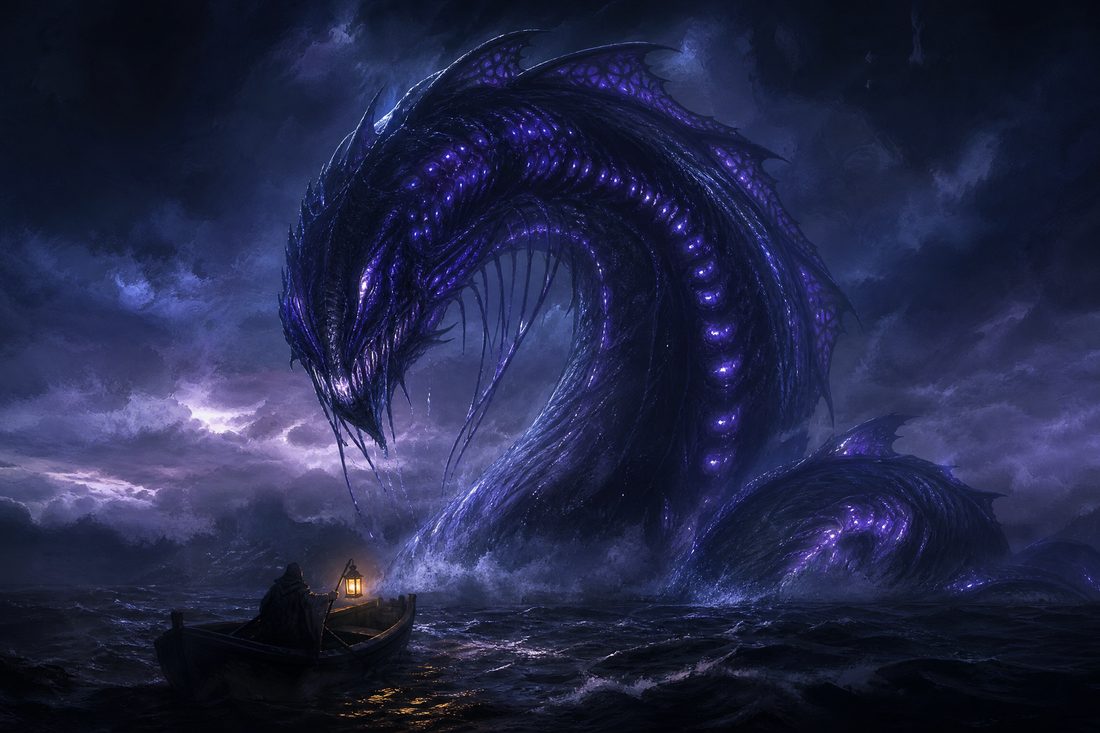
The first time the creature surfaces, the entire desk stopped working and came to watch. It rises out of black water across what feels like half a minute, bioluminescence running down its flank, and the boat you are standing on tilts far enough that you have to brace. It is the single best-staged moment in four hundred and eleven logged encounters.
The fourth time, we timed it. Two minutes and fourteen seconds, then the second phase begins, regardless of anything you have done.
How we tested it
Four runs at four damage profiles: attacking normally, attacking at roughly half rate, attacking as fast as possible, and not attacking at all. If the transition were driven by the creature's health, the last run would never have reached phase two. It reached it at two minutes and fifteen seconds.
This is not an unusual technique and it is not automatically a fault. Timed phases let a designer stage a spectacle reliably, which is presumably why this fight looks the way it does. The problem is what it costs.
What a timer takes away
In a damage-driven fight, your competence changes the shape of the encounter. Play well and phase two arrives early, which means you meet the harder material with more resources and a shorter total exposure. Play badly and the fight lasts longer, which is its own feedback.
Here, neither happens. Every attempt is the same six minutes and forty seconds in the same order. Improvement does not shorten the fight, it merely makes you safer inside a fixed runtime, and the encounter cannot respond to you at all.
A boss that cannot be beaten faster cannot tell you that you are getting better. It can only tell you that you are still alive.
The tells are extremely generous
Twenty-two frames at the shortest, the longest minimum in this issue. Everything the creature does is announced enormously, which suits its scale and means the fight is never confusing. Our named-cause figure of seventy-one per cent is depressed almost entirely by the camera.
Sixteen per cent of deaths came from the view. When something this large moves close to a boat this small, the camera pulls in and loses the horizon, and twice we drowned without ever seeing what hit us.
| Measure | Tidewake | Archive median |
|---|---|---|
| Shortest tell | 22 frames | 18 frames |
| Attempts to first clean phase | 3 | 14 |
| Damage-driven transitions | 0 of 3 | 3 of 4 |
| Fixed runtime per attempt | 6:40 | Variable |
| Named-cause deaths | 71% | 84% |
The case for it anyway
Seven point two is not a dismissal. There is a real argument that this encounter is not trying to be a test and should not be judged as one — that it is a set piece you participate in, closer to a sequence than a duel, and that the fixed runtime is what allows its staging to be reliable.
We take that seriously, and it is why the score is not lower. But a set piece has to survive repetition to sit at the end of a game, and this one is spent by the fourth viewing. Hollow Choir solves the same problem by making two of its encounters explicitly unfightable, which is honest about what it is doing; Tidewake asks you to keep playing a fight that has stopped responding.
The short version
- The best-staged single moment in the archive.
- All three phase transitions fire on a timer, verified across four damage profiles.
- Fixed six minute forty runtime; competence cannot shorten it.
- Twenty-two frame tells, the most generous in the issue.
- Sixteen per cent camera deaths from the boat-to-creature scale problem.
Verdict
Seven point two. Worth seeing, worth about four attempts, and a reminder that spectacle and encounter design are separate crafts that happen to occupy the same screen. We would recommend fighting it once at night with the sound up, and then never again.