
There is a moment about ninety attempts into the Warden fight where the arena stops being a room and becomes a rhythm. It happens to almost everyone who logs the fight, and it happens because the encounter has been telling you the same four things from the first attempt in exactly the same way. Nothing changes. You simply start listening.
That is the whole achievement of Crowned Ash, repeated nineteen times at different scales. Every boss in this game is enormous, several of them fill the screen, and not one of them relies on you having died to learn what is coming.
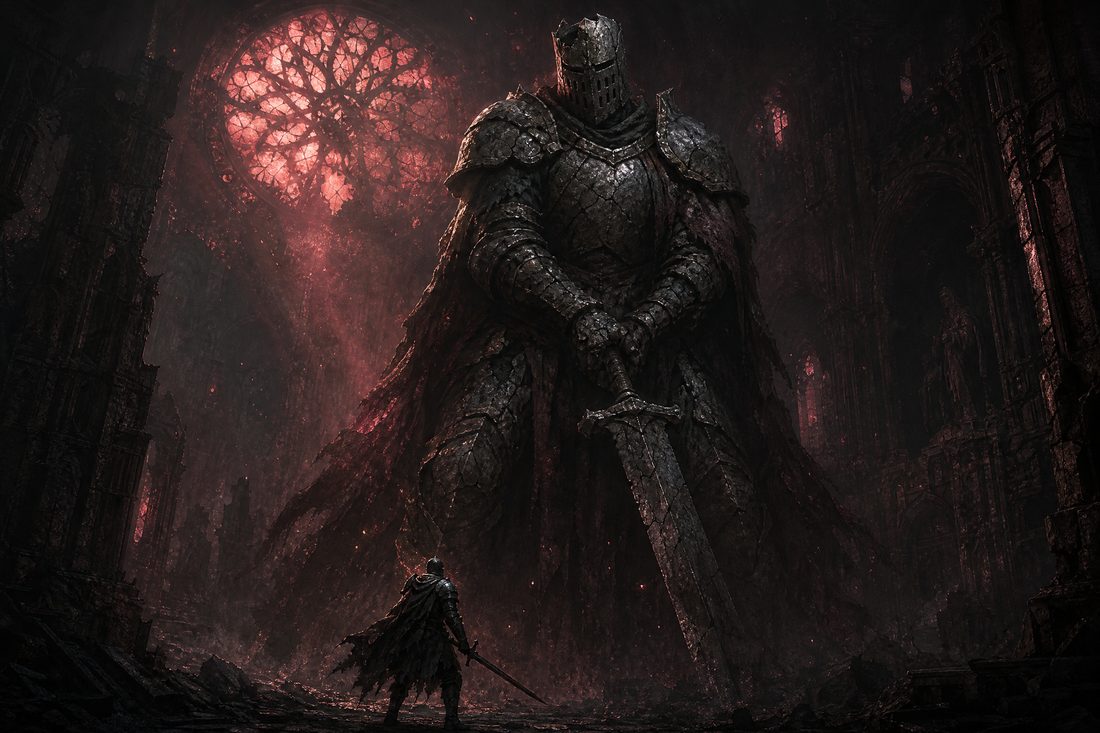
Tells you read with your eyes rather than your memory
The shortest wind-up in the entire game is sixteen frames, comfortably above the eleven-frame threshold where our archive shows players begin describing fights as unfair. But frame counts alone do not explain why this game feels generous. What does is the silhouette.
Each of the Warden's four chains begins with a different shape. The overhead starts with both shoulders rising; the horizontal sweep begins with a shift of weight onto the back leg; the grab lowers the head; the delayed thrust plants the sword and pauses. You can distinguish them at any distance, in any lighting, with the creature partly off screen, which matters because for a third of the fight it is.
| Chain | Opening tell | Frames to impact | Recovery window |
|---|---|---|---|
| Overhead cleave | Both shoulders rise | 29 | Generous |
| Horizontal sweep | Weight to back leg | 21 | Moderate |
| Grab | Head lowers, arm opens | 24 | Punishing if missed |
| Delayed thrust | Sword planted, pause | 16 after hold | Very generous |
The delayed thrust is the fight's cleverest piece of work. It plants the sword, holds for an unpredictable interval, then strikes in sixteen frames. On paper that is the fight's most demanding attack. In practice it is the easiest, because the hold is itself the tell — you are not reacting to sixteen frames, you are waiting through a pause you can see.
A fight is not fair because its numbers are large. It is fair because you can tell, without having died to it, which of the things it does is happening now.
The arena is doing more work than it looks like
The cathedral is roughly forty metres across, which sounds generous and is exactly as generous as it needs to be. Our capture shows the Warden's widest sweep covering about a third of that width, meaning there is always somewhere to be, but never anywhere restful.
More important, the room is legible. Two rows of columns give you fixed reference points, the light from the window establishes a consistent direction, and there is no clutter you can be caught on. Three per cent of our deaths were attributable to camera or geometry, against an archive median of nine and a catastrophic thirty-one in Hangar Cluster.
Nineteen bosses and no reused fights
This is the statistic that separates Crowned Ash from Sable Ring, which offers twenty-eight encounters of which nine are recolours. Every one of the nineteen here has its own moveset. Four are variations on a theme — the three Wardens and the Choirmaster share a design language — but each has attacks the others do not, and the variations arrive in an order that assumes you learned the last one.
| Measure | Crowned Ash | Archive median |
|---|---|---|
| Shortest tell | 16 frames | 18 frames |
| Attempts to first clean phase | 9 | 14 |
| Camera or geometry deaths | 3% | 9% |
| Deaths with a named cause | 97% | 84% |
| Reused encounters | 0 of 19 | 3 of 14 |
Second phases that add rather than replace
Eleven of the nineteen bosses have a second phase, and all eleven keep the first phase's moveset intact while adding to it. This sounds obvious and is rarer than it should be; our note on second phases found that just over half the archive discards the first phase's vocabulary entirely, which throws away everything the player has learned at precisely the moment they were about to use it.
The Warden's second phase adds two attacks and lengthens two existing chains. Nothing is taken away. The consequence is that the ninety attempts you spent learning phase one are an asset rather than a sunk cost, and the fight gets harder without getting less comprehensible.
What it gets wrong
The seventeenth boss, the Choirmaster, has an area attack whose visual effect obscures the floor markings the attack itself uses. It is the only fight in the game where our named-cause figure dropped below ninety per cent, and it drops to sixty-one. Somebody added a particle layer late and nobody checked it against the mechanic underneath.
There is also a run-back problem. Four bosses sit ninety seconds from their checkpoint, which on a two-hundred-attempt fight is five hours of walking. The game is otherwise so respectful of your time that this reads as an oversight rather than a philosophy.
The short version
- Nineteen bosses, no reused encounters, all readable at distance.
- Shortest tell sixteen frames; every attack has a distinct silhouette.
- Ninety-seven per cent of our deaths had a cause we could name.
- Second phases add to the first rather than replacing it.
- One fight ruined by a particle effect; four with a long walk back.
Verdict
Nine point three. The Warden is the best single encounter in four hundred and eleven logged, and the game around it holds that standard for eighteen more fights. It is difficult in the way a difficult conversation is difficult — demanding, occasionally exhausting, and never at any point unclear about what it is asking of you.