
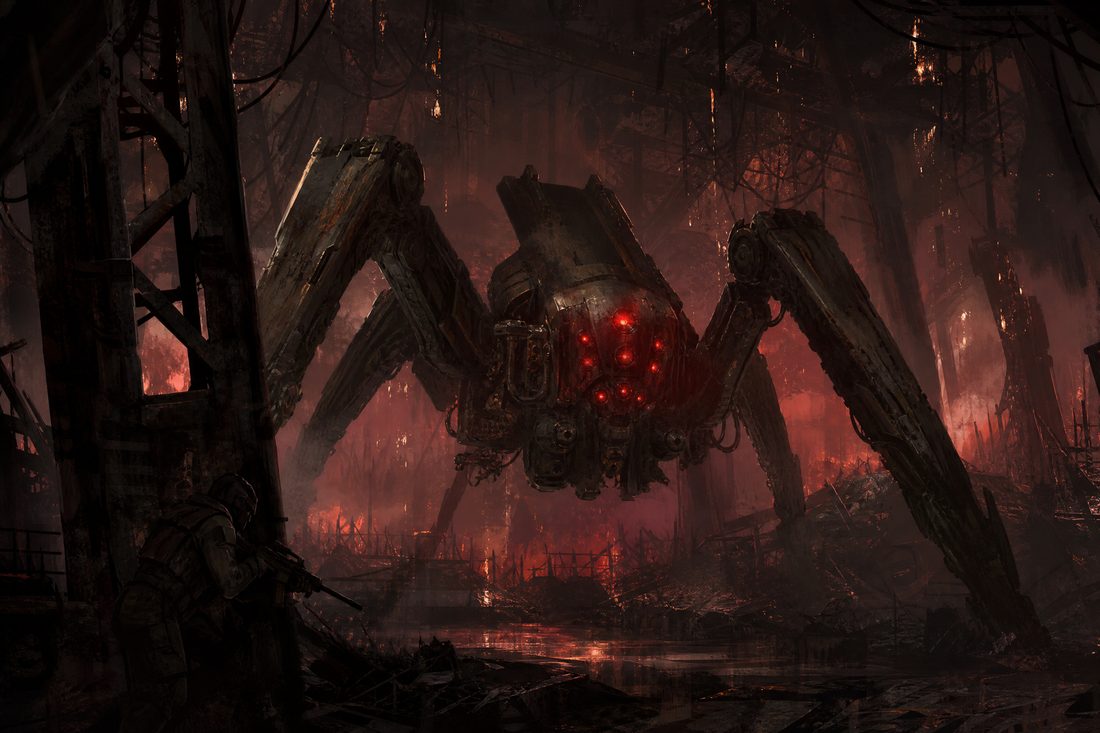
The Crane Mother is a magnificent piece of design. It is a gantry crane that has learned to walk, its attacks derive logically from what a crane does, and every one of them is telegraphed by a mechanical movement that makes sense before it makes damage. We would put it in the top twenty encounters of the archive on design alone.
We logged thirty-eight attempts on it. Fourteen of those ended with us looking at a wall.
The measurement that sinks it
For every boss we record the widest attack reach as a proportion of arena width. Where that figure sits above roughly seventy per cent, the fight stops being about positioning and becomes about the frame timing of a single dodge, because there is nowhere else to be.
Five of the six bosses here exceed seventy per cent. The Crane Mother reaches ninety-three, which means that for its widest attack the only survivable response is a dodge through the attack itself, in a room where the camera cannot show you both the creature and where you are going.
| Boss | Arena width | Widest reach | Proportion |
|---|---|---|---|
| Sorting Frame | 21 m | 17 m | 81% |
| Gantry Walker | 27 m | 20 m | 74% |
| Crane Mother | 15 m | 14 m | 93% |
| Loader Nine | 34 m | 15 m | 44% |
| Furnace Head | 19 m | 15 m | 79% |
| Rail Warden | 23 m | 18 m | 78% |
Loader Nine, at forty-four per cent, is the exception and is also the best fight in the game to play. Same design quality as the others, given room to happen in. It is the clearest possible demonstration that nothing is wrong with the creatures here.
The lock-on releases when the boss transforms
Every one of these machines reconfigures — plating retracts, arms extend, a chassis splits into two attacking halves. This is the most interesting thing about them, and each transformation drops the lock-on entirely rather than re-targeting to the new geometry.
The result is that the moment the fight becomes most interesting is also the moment the camera abandons you, mid-animation, at close range, in a room already too small. On our capture this accounts for nineteen of the forty-four camera deaths.
A lock-on that surrenders during a transformation is punishing the player for the fight's best feature.
The tells are fine
It is worth stating plainly, because a score of six point three invites the assumption that the fights are cheap. They are not. The shortest wind-up is fifteen frames, above the archive median for fairness, and every attack has a mechanically legible origin.
Our named-cause figure of fifty-eight per cent is not a verdict on the tells. It is a verdict on whether we could see them, which in five of six arenas is a different question.
| Measure | Hangar Cluster | Archive median |
|---|---|---|
| Shortest tell | 15 frames | 18 frames |
| Arenas above 70% reach | 5 of 6 | 4 of 14 |
| Camera or geometry deaths | 31% | 9% |
| Named-cause deaths | 58% | 84% |
| Lock-on drops per fight | 3.2 | 0.4 |
What a patch could fix
Almost all of it, which is the frustrating part. Widening four arenas by eight to ten metres would bring every fight under the seventy per cent threshold without touching a single moveset. Re-targeting the lock-on to the nearest valid point after a transformation is a smaller change still.
Neither would require the creatures to be redesigned, and the creatures are the reason to play this. We would happily re-audit.
The short version
- Six mechanically excellent machines, each transforming mid-fight.
- Five of six arenas too small for the boss inside them.
- Thirty-one per cent of deaths to camera or geometry, the worst logged.
- Lock-on releases on every transformation and does not re-acquire.
- Loader Nine, in a room twice the size, is one of the year's best fights.
Verdict
Six point three. A score given reluctantly to a game whose problems are all spatial and none of them creative. Loader Nine is the proof: identical design philosophy, thirty-four metres of room, and suddenly one of the finest encounters of the issue. Everything wrong here is fixable, and everything right here is the hard part.